


Georgia Executives and Employees Agree on AI's Biggest Risk
Friday, October 16th, 2026
The 2026 Business Generosity Report shows that executives and employees agree on surprisingly little about AI except for one crucial aspect. Both groups are equally concerned about the loss of human connection and damage to company culture. The alignment represents not only tremendous opportunity but also a risk that generosity is uniquely positioned to answer.
The latest report includes an extensive look at how AI is reshaping the relationship between companies and the people who work for them. The data shows two audiences with notably different experiences of AI — but one shared fear that cuts across both.
The One Thing Everyone Agrees On
AI's impact on the workplace isn't landing well. 67% of employees and 54% of executives report mixed or negative feelings about it. When given a wide range of options for how AI could negatively affect the workplace, one answer rose to the top on both sides of the executive-employee divide:
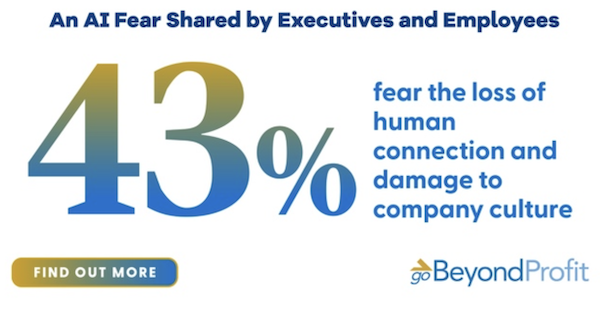
43% of executives and 43% of employees independently named loss of human connection
and damage to company culture as AI's #1 workplace risk.
It is the single point of full agreement in the entire survey. Executives flagged other risks more prominently than employees did, such as role elimination (41% of executives vs. 24% of employees) and loss of creative or critical-thinking skills (44% vs. 34%).
Values Under Pressure
Another revealing data point isn't about optimism or pessimism. It's about whether company values are holding up as AI drives decisions.
72% of employees do not believe their company's values are actively driving AI integration — 3 in 4 employees watching the most significant workplace transformation in a generation without seeing values as a compass.
The most common employee answer isn't skepticism, but a diagnosis of employers trying and losing ground: 33% say their company is "trying to let values guide us, but AI moves faster than our framework." Another 22% say their company hasn't connected its values to its AI strategy at all, and 17% see AI adoption as driven purely by efficiency and cost, with values not a factor.
Executives are considerably more confident: 45% say their company's values are actively shaping how AI is implemented, compared to just 28% of employees who agree. That 17-point gap likely reflects executives grading their intentions versus employees reporting what they are experiencing.
What Employees Are Actually Asking For
Employees aren't asking for certainty about what AI will do. Their asks are specific and, notably, achievable:
- Communication: Clear, plain-language communication about how AI will affect the work is the foundational request. Yet only 46% of executives say they are currently offering this. Employees aren’t asking for certainty about what AI will do. They’re asking to be told what the company knows as it learns it. That’s a low-cost, high-return investment.
- Employee voice: Employees want input into how AI changes their work. 43% of executives report offering this. This is a reasonable starting point but leaves a meaningful share of the workforce watching decisions get made without their involvement.
- Time to adapt: Time and support to adjust as AI changes the work rounds out the top three requests, with 40% of executives reporting they offer it. Of the three, this is the most concrete request for training, transition time, and resources to navigate real changes to how work gets done.
These are not outrageous demands. They are the same things a generous culture already provides. Companies with a track record of generosity are better positioned to deliver on all three because the habits are already in place.
AI is now the live test of whether a company's stated values hold up when real pressure hits. The 2026 Business Generosity Report gives employers a benchmark for where generosity investments are earning genuine credit and how to close the gap between executive intent and employee experience.

